Why the Oahspe Should Be Read Slowly
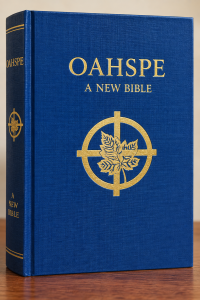 The Oahspe Bible is not a book that greatly rewards hurried reading. Its language, imagery, unusual vocabulary, spiritual teachings, and vast accounts of heavenly and earthly affairs can easily overwhelm the reader who attempts to move through it too quickly. There is a difference between reading the words of Oahspe and absorbing what Oahspe is attempting to teach. For the Faithist, the second is far more important.
One may read twenty pages and remember almost nothing, or read a single paragraph carefully and carry its lesson throughout the day. Spiritual reading should therefore not be measured chiefly by the number of pages completed. The purpose is understanding, reflection, and application.
Even an experienced reader can find Oahspe difficult in places. Names appear that are unfamiliar. Different heavenly regions are discussed. Ancient peoples and periods are described. Special terms such as corpor, es, atmospherea, etherea and Uz occur throughout the work. Trying to understand all of this at once can make reading unnecessarily difficult. There is no need to hurry.
When an unfamiliar term appears, stop and determine what it means. When a passage seems particularly important, read it again. When several ideas are presented together, consider them separately. Above all, when a passage speaks directly to your spiritual life, remain with it for a while.
This is particularly appropriate because The Book of Discipline encourages the individual to seek the Creator:
“Remember thy Creator and seek to discover Him in the best perfections.”
— Book of Discipline 14:19
Reading Oahspe should ultimately help us do precisely that: remember Jehovih and seek Him more fully.
Do Not Read Merely to Finish
There can be a temptation when approaching a large sacred book to make finishing it the principal objective. We begin counting pages. We calculate how many chapters remain. We may even feel that reading five chapters is somehow spiritually superior to reading one. However, finishing a book and understanding a book are quite different accomplishments.
If you read a chapter of Oahspe and discover one principle that changes the way you treat another person, that reading has borne fruit. If you read fifty pages but afterwards cannot remember what you have read, speed has accomplished very little. There is no prize for reaching the final page quickly. The aim should be to allow the teachings to enter the mind gradually and, where they are found worthy, to become part of one’s life.
Reading slowly is especially important because Oahspe itself does not encourage thoughtless acceptance.
One of the strongest passages in The Book of Inspiration is:
“But thou shalt rely on thine own inspiration from thy Creator.”
— Book of Inspiration 9:10
The surrounding passage is remarkable. It tells the reader to exercise judgement concerning sacred books and teachings rather than accepting something simply because a person, angel or a god has spoken it. It distinguishes such indirect sources from the direct inspiration of the Creator within the individual.
This means that the Faithist should not approach Oahspe with the attitude: “I must accept these words without thinking about them.” A better attitude is: “I will read carefully, seek Jehovih’s Light, consider what is being taught, and endeavour to understand its spiritual meaning.”
That cannot easily be done at great speed. Discernment requires time.
Pause When Something Speaks to You
Sometimes a single sentence deserves more attention than an entire chapter.
Suppose you encounter this teaching:
“To be one with Jehovih, this is Godliness.”
— Book of Discipline 14:13
Do not immediately hurry onwards. Stop. Consider what it means.
- What would it mean for me to become more conscious of Jehovih today?
- Are my thoughts leading me towards the Creator or away from Him?
- Does my behaviour reflect the Light I claim to follow?
- Am I becoming more loving?
- Am I becoming more truthful?
- Am I becoming more useful to others?
- Am I actually practising what I profess?
At that point you are no longer simply reading Oahspe. You are allowing Oahspe to become a means of examining your life. That is far more valuable than completing another ten pages.
Read the Oahspe Bible in Small Portions
For devotional study, a small portion may often be sufficient. Read several verses or a short chapter. Then stop.
Ask yourself three simple questions:
What does this passage say? First determine the straightforward meaning of the words.
What spiritual principle does it contain? Look beneath unfamiliar terminology and historical material for the underlying lesson.
How should this affect my life? This is perhaps the most important question. If the passage concerns truthfulness, consider your speech. If it concerns service, consider whom you can help. If it concerns selfishness, examine your motives. If it concerns Jehovih’s presence, spend some time quietly remembering the Creator. If it concerns forgiveness or restitution, consider whether there is something in your own life that should be corrected. Reading then becomes practice.
Allow Time for Jehovih
There is another reason for reading slowly. The Oahspe repeatedly presents Jehovih as the Source behind life, knowledge and spiritual illumination. The Book of Inspiration says:
“I am the Light that illuminateth thy soul.”
— Book of Inspiration 1:6
A Faithist reading of Oahspe need not be purely intellectual. There is a place for study. There is a place for analysing terminology and comparing passages. There is certainly a place for asking difficult questions. However, there should also be a place for silence.
After reading something important, close the book for a moment. Be still. Think about what you have read. Turn your attention towards Jehovih.
You might simply pray: Jehovih, give me Light to understand what is good and true, and wisdom to put it into practice.
Then remain quiet for a little while. Five minutes spent in genuine reflection may sometimes accomplish more than another hour of hurried reading.
Some Passages Will Require More Than One Reading
Do not be discouraged when you encounter portions of the Oahspe that you do not immediately understand. This is normal. The sacred book contains its own terminology and presents an enormous spiritual cosmology. Some concepts become clearer only after encountering them repeatedly in different contexts. Something puzzling today may make considerably more sense six months from now.
Mark the passage. Make a note. Ask questions. Compare it with other passages. Then continue. We are not required to understand everything during your first reading. Indeed, Oahspe is better approached as a book to be studied repeatedly than as a book to be read once and placed upon a shelf.
Give Special Attention to the Practical Books
For Jehovih’s Faithists, the practical and devotional portions of Oahspe deserve particular attention. For example, The Voice of Man, The Book of Jehovih, The Book of Inspiration, The Book of Discipline, The Book of Judgment, God’s Book of Ben, and The Book of Jehovih’s Kingdom on Earth can be returned to repeatedly. One does not need to master the whole cosmology before beginning to live as a Faithist.
- Begin with what you understand.
- Remember Jehovih.
- Seek His Light.
- Practise truthfulness.
- Correct your faults.
- Serve others.
- Develop compassion.
- Put away selfishness.
- Do the good that is presently within your power.
The Book of Discipline describes the spiritual life in very practical terms:
“To strive continually to comprehend the right, and to do it — this is excellent discipline.”
— Book of Discipline 13:8
That verse provides an excellent principle for reading the Oahspe itself.
Comprehend the right — and do it.
Understanding and practice belong together.
Let the Oahspe Accompany You
There is no reason to hurry through Oahspe. Let it accompany you. Read a little in the morning.
Think about a verse during the afternoon. Return to a difficult passage another day. Keep notes. Underline important teachings if the book belongs to you. Write questions in a notebook. Discuss passages with other students when possible. Most importantly, allow what you read to turn your attention towards Jehovih and towards doing good.
A sacred book is not benefited by being read quickly, and the reader gains little simply from having passed his eyes over thousands of words.
Read slowly enough to understand. Read carefully enough to question. Read prayerfully enough to listen. Read thoughtfully enough to remember. And read practically enough that something you encounter in its pages makes you a little more truthful, a little more compassionate, a little less selfish, and a little more conscious of Jehovih.
There is no need to conquer Oahspe.
Take it slowly. Seek the Light within its teachings. Allow yourself time to think. And above all, put into practice the good that you understand.